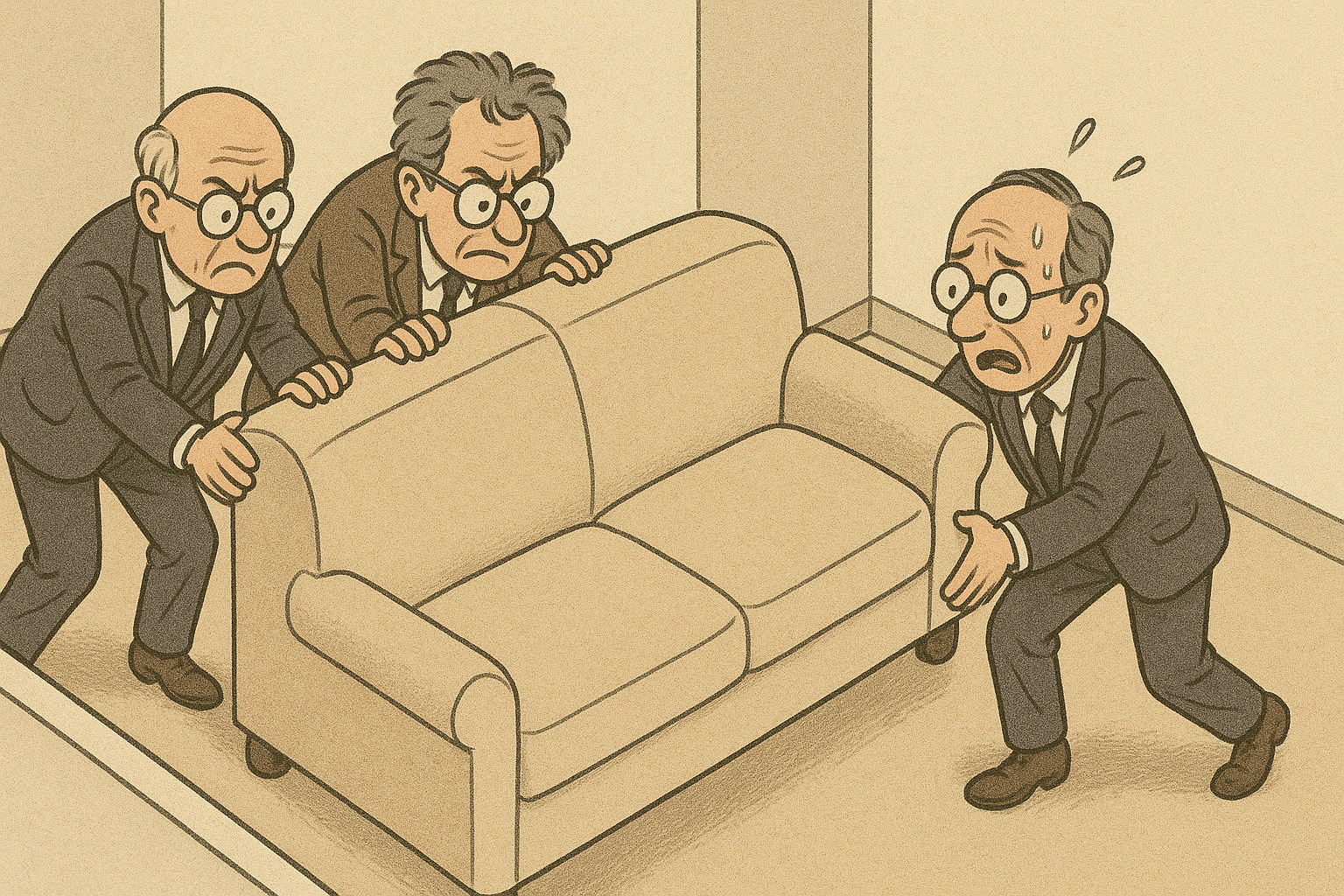

“What is the largest possible sofa that can pass through a right-angled hallway?”
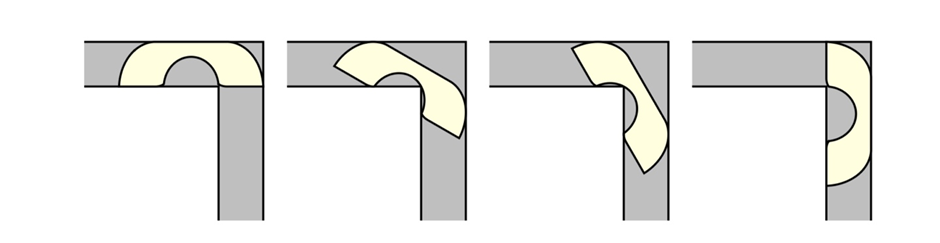
This deceptively simple question remained an unsolved puzzle in mathematics for more than half a century. First posed in 1966 by Canadian mathematician Leo Moser, the moving sofa problem asks for the maximum area of a connected planar shape that can move through an L-shaped hallway of unit width—what one might call an `ideal sofa.’ In simpler terms, it asks for the largest shape that can move freely along the horizontal hallway, navigate the corner, and then move freely along the vertical hallway. Despite being simple enough for even elementary school students to understand, it remained unsolved for nearly 60 years, standing as a major challenge in geometric optimization. In 1992, mathematician Joseph Gerver proposed a highly intricate shape made of curved segments as a strong candidate solution, but for decades, it remained unproven whether this shape was truly optimal.
The mathematician who resolved this long-standing problem is Jineon Baek. After earning his undergraduate degree in mathematics from POSTECH and completing his Ph.D. at the University of Michigan, he is currently affiliated with the June E Huh Center for Mathematical Challenges at KIAS. In December 2024, during his time at Yonsei University, he drew wide attention in the mathematical community by posting a paper on arXiv proving that Gerver’s sofa is the optimal solution to the moving sofa problem. Although the paper has not yet undergone peer review, there is a broad consensus that his argument is correct.
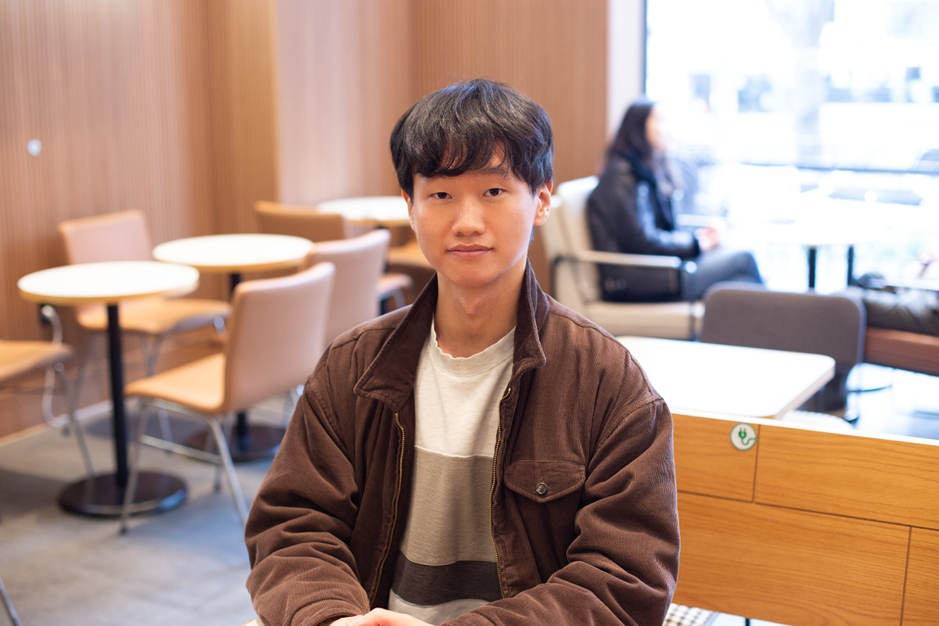
At a café in Sinchon, Jineon Baek shared detailed insights into his proof of the moving sofa problem. His proof can be divided into two main steps. The first step is to narrow down the class of sofas under consideration. Roughly speaking, this step shows that any maximum-area sofa must resemble Gerver’s sofa. The resulting four conditions are as follows:
- It is monotone.
- It is balanced.
- It rotates through $90^\circ$.
- It satisfies the injectivity condition.
Here, conditions (1) and (2) were established by Gerver, and for (3), Gerver showed that the rotation angle lies between $60^\circ$ and $90^\circ$, whereas Baek proved that the rotation angle can be $90^\circ$. Condition (4), the most crucial part of the proof, was introduced and established by Baek himself. Let us now take a closer look at each of these conditions.
(1) Monotone sofa
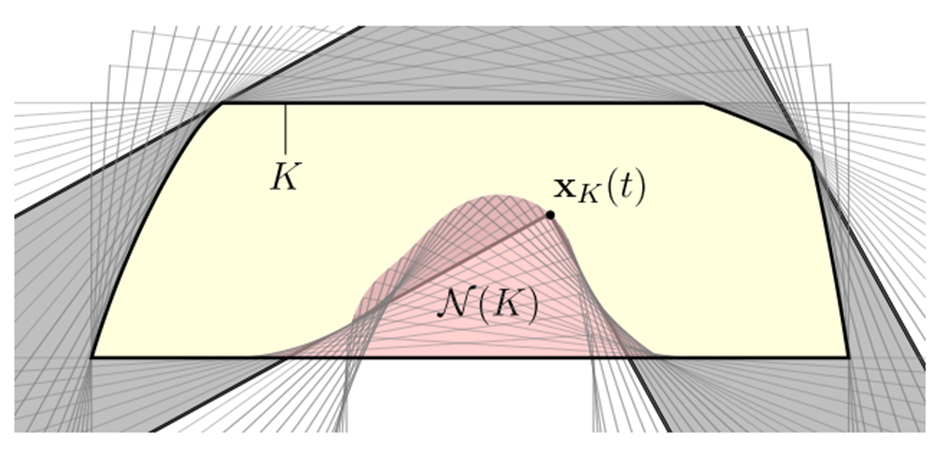
A sofa is called monotone if it rotates in a single (clockwise) direction as it moves through the hallway. In particular, it does not move back and forth during motion, unlike a car maneuvering in tight space. Moreover, throughout its movement, the sofa remains in contact with the outer walls of the hallway. Under this condition, the sofa can be identified with the intersection of rotating hallways, and one can define a convex body $K$, whose supporting lines correspond to the outer walls. As this convex body $K$ rotates inside the hallway, the inner corner of the hallway carves out a region, called the niche $\mathcal{N}(K)$. With this notation, the sofa $S$ can be expressed as $K \setminus \mathcal{N}(K)$. Such a sofa is called a monotone sofa.
(2) Balanced sofa
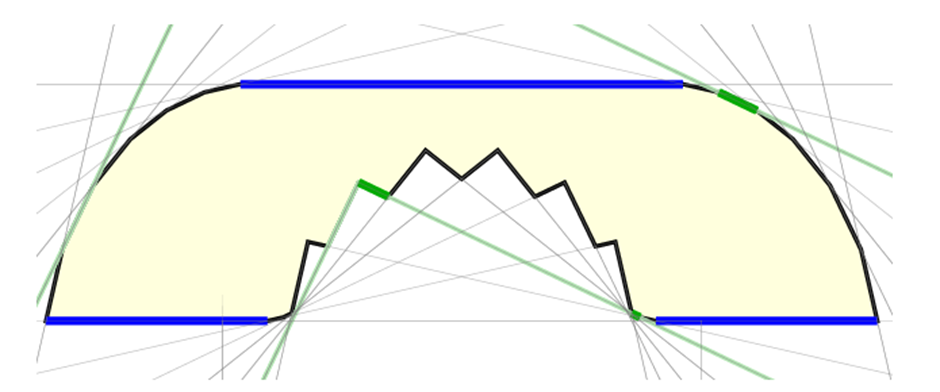
Fix a finite set of angles $\Theta$, and approximate the sofa $S$ by the intersection $S_{\Theta}$ of hallways rotated by angles in $\Theta$. Then $S_{\Theta}$ is a polygon. A sofa is called balanced if, for any unit vector $\mathbf{v}$, the total length of all edges whose outward normal vector is $\mathbf{v}$ equals the total length of those with normal vector $-\mathbf{v}$. If this condition fails, one can push the corresponding rotated hallway in the direction where the total length is larger, thereby increasing the area slightly. Hence such a sofa cannot have maximum area. Although this condition was first defined for polygonal sofas, it can be shown that a sequence of balanced polygon sofas converges to a maximum-area sofa. This condition plays an important role in establishing the $90^\circ$ rotation property in (3) and the injectivity condition in (4).
(3) It rotates through $90^\circ$.
Although the hallway $L$ has a right-angled corner, it is not obvious that a sofa must rotate by $90^\circ$. In fact, Gerver1992 showed that the rotation angle $\omega$ of a maximum-area sofa lies between $60^\circ$ and $90^\circ$. Later, Kallus and Romik2017 improved the lower bound to approximately $81.2^\circ$. Baek further proved that the rotation angle can in fact be $90^\circ$. A brief outline of the argument is as follows.
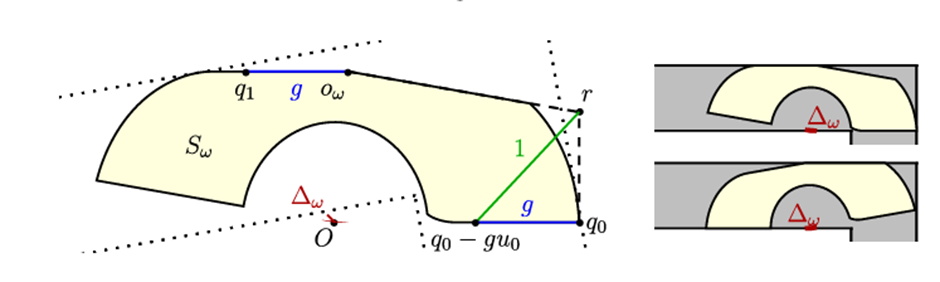
Assume that a maximum-area sofa $S$ rotates only by $\omega < 90^\circ$. Using the balance condition in the horizontal direction, one can show that $S$ has additional room to rotate further by $90^\circ – \omega$ inside the hallway. Therefore, a maximum-area sofa can rotate through $90^\circ$ while moving around the corner.
(4) Injectivity condition
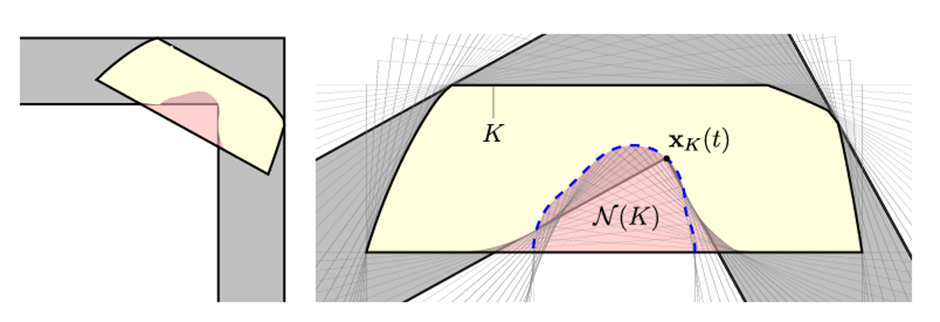
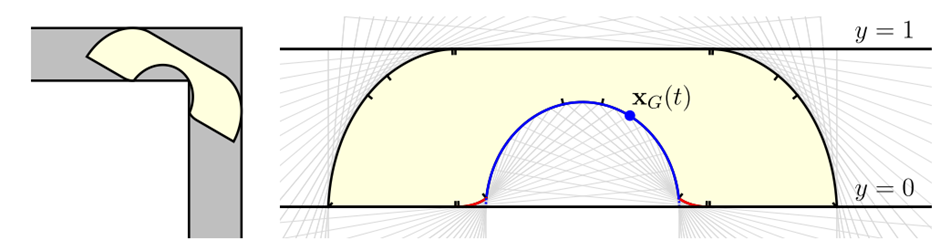
The injectivity condition means that the trajectory $\mathbf{x}(t)$ of the inner corner of the rotating hallway does not intersect itself; that is, $\mathbf{x}(t)$ is an injective function. Under this condition, the area carved out by the corner can be expressed exactly using Green’s theorem, which plays a crucial role in obtaining a sharp upper bound for the area in the proof.
\[
|\mathcal{N}(K)| \geq \text{(blue region)} = \frac{1}{2} \int_0^{\pi/2} \mathbf{x}(t) \times \mathbf{x}'(t) \, dt
\]
Baek first observed this condition in simulations. By repeatedly modifying the sofa so that it satisfies the balanced condition in (2), he found that all trajectories become injective and do not intersect themselves. To show that this phenomenon is not merely empirical but can be justified rigorously, he derived an ODE starting from the balance condition:
\[
\langle \mathbf{A}'(t), \mathbf{v}_t \rangle
= \langle -\mathbf{B}'(t), \mathbf{v}_t \rangle
+ \langle \mathbf{x}'(t), \mathbf{v}_t \rangle
\]
If one assumes that the sofa contacts the hallway at three points $A(t)$, $B(t)$, and $\mathbf{x}(t)$ during its motion, then the balance condition can be written as an equality. However, since such contact points cannot be guaranteed to always exist, this relation is generalized into an inequality that holds regardless of contact:
\[
\langle \mathbf{A}'(t), \mathbf{v}_t \rangle
\leq \max\left( \langle -\mathbf{B}'(t), \mathbf{v}_t \rangle, 0 \right)
+ \left| \langle \mathbf{x}'(t), \mathbf{v}_t \rangle \right|
\]
From this, one can deduce that $\langle \mathbf{x}'(t), \mathbf{u}_0 \rangle < 0$, and hence $\mathbf{x}(t)$ does not intersect itself. This provides a rigorous justification of the injectivity condition.
The second step of the proof is to establish an upper bound on the area for the class of sofas $\mathcal{S}^i$ obtained in the first step.
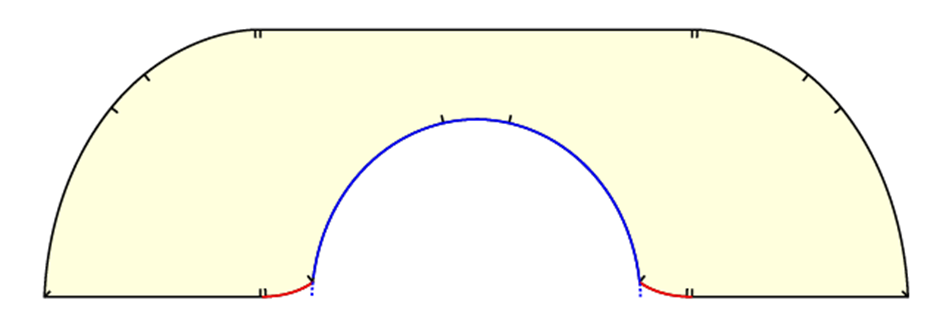
To this end, Baek defines a larger region $R$ containing the sofa $S$, and uses $\mathcal{Q}(S)$ as an upper bound for the area. This region $R$ consists of a core (the blue curve in the figure) and two tails (the red curves), generalizing the structure of Gerver’s sofa. He then focuses on the cap $K$, the main part of $R$, and divides it into left, middle, and right regions. The area is computed by considering only the contributions from the walls or the inner corner in each region. In particular, in the middle region, the injectivity condition ensures that no self-intersection occurs, allowing the area to be expressed rigorously using Green’s theorem.
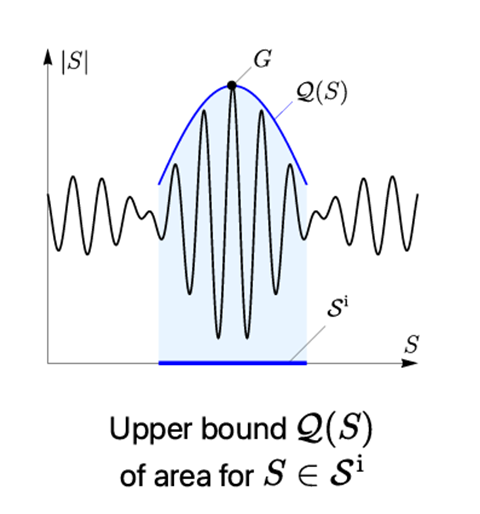
In the next step, Baek shows that $\mathcal{Q}(K)$ is a quadratic, concave function defined on convex bodies. In particular, for Gerver’s sofa $G$, this upper bound coincides exactly with its area. Moreover, by proving that $G$ is a local maximum of $\mathcal{Q}$, and using the fact that $\mathcal{Q}$ is quadratic, he concludes that $G$ attains the maximum area.
Baek solved the problem after seven years of persistent effort. Although the key idea behind the solution emerged after about three years, it took considerably longer to turn it into a rigorous mathematical proof and a complete paper. At first, he explored a computer-assisted approach and even developed working code.
However, the code was too long and complex; while it confirmed that a proof was possible, it was difficult to turn it into a clear and complete argument. In the end, he chose to simplify the proof, and in doing so, no longer needed to rely on computers. Reflecting on the two years he had spent developing the code, he described the experience as “bittersweet.” “If I had continued in that direction, it probably would have taken another year to present the proof. I thought it was much better to finish now than a year later. It was a complicated feeling,” he said.
What allowed Baek to devote seven years to a single problem? As a student, he enjoyed solving challenging problems on an online Olympiad forum known as XMO, often tackling questions that others could not solve. He recalls that spending months thinking about a single problem and eventually solving it played a crucial role in his approach to the moving sofa problem. “Through such experience, I developed a sense of whether a problem might eventually be solvable. From the beginning, I had a feeling that the sofa problem could be solved,” he said.
Baek grew up in a financially difficult environment. Although his mathematical ability could have led him to more lucrative career paths, he chose to pursue the demanding path of pure mathematics. “After learning in elementary school that mathematics could be a career, I think I have always dreamed of becoming a mathematician. I simply continued along that path,” he said. “Even if I had chosen a different career, I don’t think I could have let go of the beauty of mathematics.”
He also noted that, despite financial difficulties, his mother actively sought out opportunities for him, which eventually led him to the Global Institute for Talented EducationGIFTED at KAIST. One of the KAIST students who taught him there later became his postdoctoral advisor, Professor Jun-Kyung Lee of Yonsei University. “While preparing for Korea Science AcademyKSA, my middle school teachers supported me in many ways, even pooling their own money to buy me a laptop and send me to an English academy. After entering KSA, I continued to receive tremendous support from my teachers. Thanks to all that support, I was able to come this far. I have always felt that I should give back someday,” he said. Baek’s story reflects not only by his own dedication, but also the support of those around him and the opportunities society provided.
Baek plans to continue working on geometric optimization problems such as the moving sofa problem. Recently, he has become interested in polygon packing problems, which study how congruent regular polygons can be arranged as densely as possible in the plane under rotations and translations. While the case of pentagons has already been solved, he hopes to explore other types of polygons. He is also interested in a four-dimensional analogue of the Kepler conjecture—namely, the problem of optimally packing unit spheres in four-dimensional space—and hopes to approach it using computer-assisted methods.

